Fauci Contempt Case Moves to DOJ as Fifth Amendment Fight Intensifies
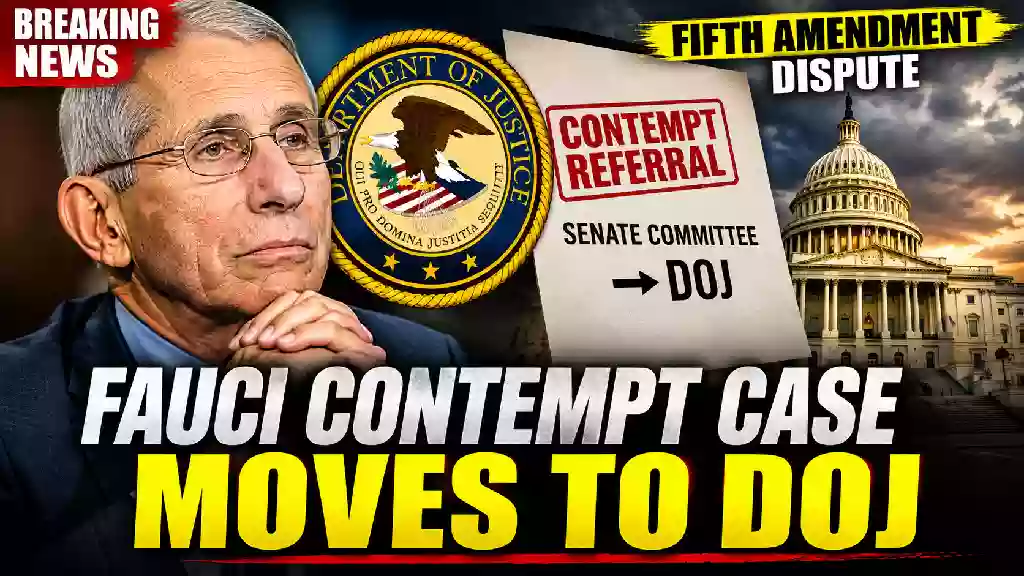
Anthony Fauci faces a Senate contempt referral to the Department of Justice following his repeated invocation of the Fifth Amendment during congressional testimony.
Fauci Contempt Case Moves to DOJ as Fifth Amendment Fight Intensifies
Senate committee referral puts Justice Department at the center of a growing legal battle over Anthony Fauci’s congressional testimony
The legal dispute surrounding Dr. Anthony Fauci is entering a new stage after a Senate committee voted along party lines to hold the former federal health official in contempt of Congress.
The committee’s action followed Fauci’s appearance before the Senate Committee on Homeland Security and Governmental Affairs, where he invoked his Fifth Amendment right against self-incrimination more than 100 times. The contempt referral has now been sent to the U.S. Department of Justice, which confirmed that it received the matter and is reviewing it in coordination with the Senate.
The case raises a complicated constitutional question: How far can a congressional witness rely on the Fifth Amendment when lawmakers are investigating government conduct?
Fauci Defends His Decision to Invoke the Fifth
Fauci has argued that he had legitimate reasons to fear potential criminal exposure and therefore believed invoking the Fifth Amendment was appropriate.
The Fifth Amendment protects individuals from being compelled to provide testimony that could expose them to criminal prosecution. But the scope of that protection is now at the center of the dispute over Fauci’s testimony.
Attorney Sam Rajovsky, who discussed the matter in the source material, said Fauci could have grounds to invoke the privilege when questions relate to conduct that could potentially expose him to prosecution. At the same time, Rajovsky questioned whether the privilege could reasonably extend to every question asked during the hearing.
That distinction could become critical if federal prosecutors examine the contempt referral.
Questions Over Blanket Refusal to Answer
One of the most controversial aspects of Fauci’s testimony was his repeated refusal to answer questions, including questions that, according to the attorney interviewed, did not appear directly connected to potential criminal liability.
Rajovsky argued that questions unrelated to possible criminal conduct could present a different legal issue from questions that might genuinely trigger Fifth Amendment protections. Whether such refusals constitute criminal contempt, however, depends on the applicable law and circumstances.
The disagreement highlights the broader tension between congressional investigative powers and constitutional protections available to witnesses.
DOJ Review Could Determine What Happens Next
The Justice Department now faces the task of reviewing the Senate referral and determining what action, if any, should follow.
The process may not be immediate. According to Rajovsky, congressional contempt referrals can involve statutory and procedural requirements, including provisions under Section 194 of the U.S. Code concerning certification of criminal contempt referrals.
That means the Senate’s vote does not automatically guarantee a criminal prosecution.
The Justice Department could ultimately decide to pursue the matter, seek additional information, or decline to take further action. The source material does not establish which course federal prosecutors will choose.
State Investigations Could Become a Major Factor
Even if the federal referral does not result in prosecution, the controversy could continue through state-level investigations.
Rajovsky pointed to inquiries involving Fauci in several states, including Florida, and emphasized that federal and state jurisdictions are legally distinct. He argued that a federal pardon would not necessarily prevent state authorities from investigating conduct potentially covered by their own laws.
The possibility of state investigations therefore adds another layer to an already complicated legal dispute.
Could Fauci Face Additional Legal Challenges?
The congressional investigation could also have consequences beyond the contempt referral.
Rajovsky suggested that Fauci could potentially face civil litigation, although he acknowledged that issues such as immunity and statutes of limitations could affect any future lawsuits. He also pointed to documents, emails and other material obtained through congressional oversight that could be examined by investigators.
However, the existence of evidence or an investigation does not itself establish criminal or civil liability. Any future case would have to be evaluated under the applicable law and evidence.
A Bigger Constitutional Question
The Fauci controversy could ultimately become significant beyond the former federal health official himself.
If prosecutors pursue the contempt case and it reaches the courts, judges could be asked to consider the limits of congressional subpoena authority and the protections provided by the Fifth Amendment.
Rajovsky described the constitutional questions as significant and said a successful prosecution could potentially lead to further appeals and eventually Supreme Court consideration. He also acknowledged that Fauci may have a legitimate constitutional argument for invoking the privilege in connection with questions that could expose him to criminal prosecution.
For now, the next major developments will come from the Justice Department and state authorities. The Senate’s contempt vote has placed Fauci’s congressional testimony under renewed legal scrutiny, but whether that scrutiny ultimately leads to prosecution remains uncertain.
#AnthonyFauci #Fauci #ContemptOfCongress #FifthAmendment #DOJ #DepartmentOfJustice #RandPaul #Congress #Senate #CongressionalOversight