At 103 years of age, WWII Veteran Don Cotton Still Shares Lessons of Service, Faith, and Respect
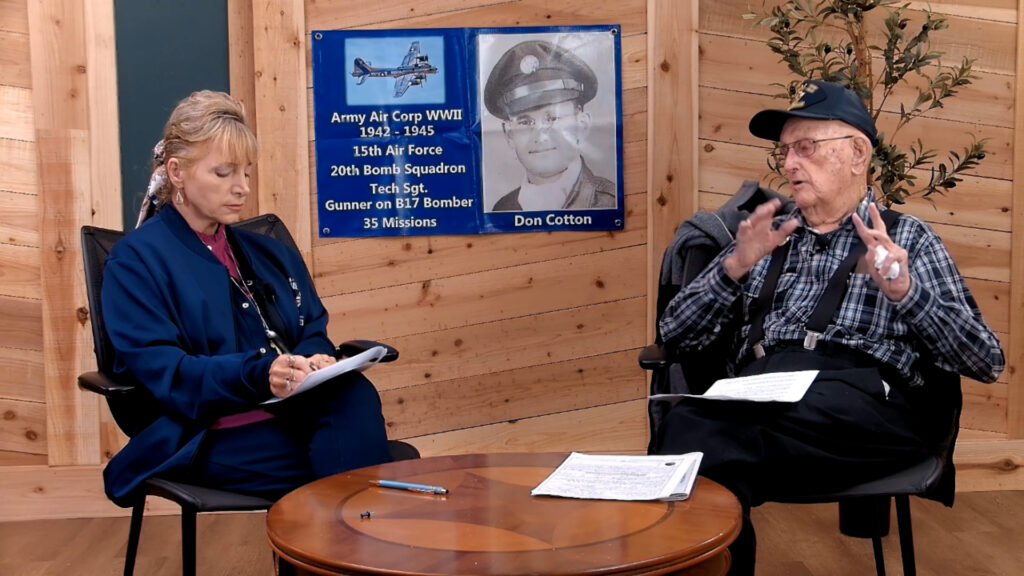
At 103, WWII Veteran Don Cotton Still Shares Lessons of Service, Faith, and Respect
By The Henryettan | Local News
At 103 years old, Don Cotton of Henryetta still drives himself to the grocery store, walks on his own, and speaks with clarity about a life that spans some of the most defining moments in American history. On Monday morning, Cotton sat down with Guardians of Service host Tricia Bear for an in-depth interview reflecting on his childhood, his service as a B-17 bomber gunner during World War II, and the values he believes future generations must not forget.
Cotton served in the U.S. Army Air Forces from 1942 to 1945, flying 35 combat missions over Europe as a waist gunner aboard a B-17 heavy bomber with the 20th Bomb Squadron, 15th Air Force, stationed in Foggia, Italy.
From Rural Oklahoma to World War II
Born and raised near Purcell and Pauls Valley, Oklahoma, Cotton grew up in a large family with nine children—five girls and four boys. Life during the Great Depression was simple and demanding. The family raised their own food, milked cows, gathered firewood for heat, and lived without electricity or running water.
“We were poor,” Cotton recalled with humor, “but we didn’t know it. Everybody lived that way.”
He graduated from Whitebead High School in 1942, then attended a government-run communications school in Cushing and Tonkawa, Oklahoma. Soon after, a recruiter from Vance Air Force Base visited the school—setting Cotton on a path that would take him halfway around the world.
Becoming a B-17 Gunner
Cotton enlisted in the Army Air Forces and initially worked in clerical and transportation roles before applying for flight cadets. When his eyesight disqualified him, he made a pivotal decision.
“They offered to send me back to typing,” he said. “I told them I’d rather go to gunnery school.”
That choice led him to Las Vegas for gunnery training, then to Sioux City, Iowa, where he joined a bomber crew already midway through training. Despite the dangers—including a mid-air collision during training where his aircraft dropped 10,000 feet—Cotton and his crew pressed on.
35 Missions Over Enemy Territory
Flying combat missions out of Italy, Cotton and his crew endured flak, engine fires, and near-disasters. In one harrowing moment, a piece of enemy flak tore through the fuselage, exploding ammunition inches from Cotton’s position.
“The powder exploded in my face,” he said. “Cut my heated cord. At 20,000 feet, that mattered.”
Another mission ended with a burning engine and a forced landing just beyond the front lines in Italy. Still, remarkably, every member of his 10-man crew survived the war without injury.
“We were like a family,” Cotton said. “We depended on each other.”
Honoring the Tuskegee Airmen
One of the most powerful moments of the interview came when Cotton spoke about the Tuskegee Airmen, the all-Black fighter pilots who escorted his bomber group.
“They never got the credit they deserved,” he said. “They covered us on every mission. We couldn’t have asked for better protection.”
Cotton emphasized that racial or religious differences were never an issue within his crew, which included three Jewish airmen.
“We didn’t even know what antisemitism was,” he said. “We loved each other.”
Faith, Survival, and Gratitude
Before every mission, Cotton said his crew prayed together.
“Without exception,” he noted. “And we all came back.”
That faith, he believes, played a role in their survival. For his service, Cotton received numerous honors, including the Air Medal, European-African-Middle Eastern Campaign Medal, Good Conduct Medal, and a Certificate of Valor—issued years after his discharge and signed by a lieutenant general.
Life After the War
After returning home, Cotton built a long civilian career with Texaco, working 33 years in various administrative and management roles across Texas. He raised two sons and has been married a combined 72 years—38 years to his first wife and 34 years to his current wife, Gene, who is from Henryetta.
His advice for a lasting marriage?
“Communicate. Respect each other. And let your wife have the last word.”
Why Henryetta Feels Like Home
Cotton moved to Henryetta because of his wife’s roots but stayed because of the community.
“It’s one of the friendliest places I’ve ever lived,” he said. “Oklahoma is a good state, and Henryetta is a good town.”
He remains active with VFW Post 539, the Disabled American Veterans, and is a 50-year Master Mason.
Wisdom at 103
When asked how the world has changed, Cotton didn’t hesitate.
“Drastically—and not for the better,” he said, citing a loss of respect and growing division.
His advice for future generations is simple but firm:
“Love and respect. Respect is something we’ve lost. Love your neighbor. Put God first.”
As for reaching 103 years old, Cotton shrugs.
“I don’t have an answer,” he said. “I tried to live a good life. Never held a grudge. The good Lord takes care of us.”
A Living Piece of History
With fewer World War II veterans remaining each year, Don Cotton represents a living connection to a generation shaped by sacrifice, unity, and duty.
“I don’t regret anything,” he said. “I’m glad I served. And I believe the results of that war benefited the world.”
For Henryetta—and for generations to come—Don Cotton’s story stands as a reminder of resilience, humility, and enduring faith.